
Using AI Voice Agents for Outbound Sales – Metrics 101
Deploying profitable outbound AI voice agents is a challenge. Plus, if you’re tracking the wrong performance indicators, your project is likely heading towards economic disaster.
A lot of teams boast: “I replaced my SDR with an AI voice agent…”, or “AI voice agents don’t take holidays…”
Then a month or so later, CPA is in the dirt, connect rates have slipped, and you’re spending so much credit making dogsh*t calls with your voice agent, you’ll want to curl up and die.
We’ve seen it – after running tens of thousands of live AI calls across different scripts and data qualities, one thing was clear: AI voice agent performance in outbound sales boils down to a small set of unglamorous metrics. Miss these, and the whole system will be lying to you.
This guide breaks down four metrics that we anchor our outbound AI voice agent deployments around: connect rate, qualification ratio, response speed, and impact on CPA.
Let’s get in to it 🤘
1. Connect rate is what everything else depends on
If your AI voice agent isn’t getting people on the other end of the phone, not much downstream of that really matters.
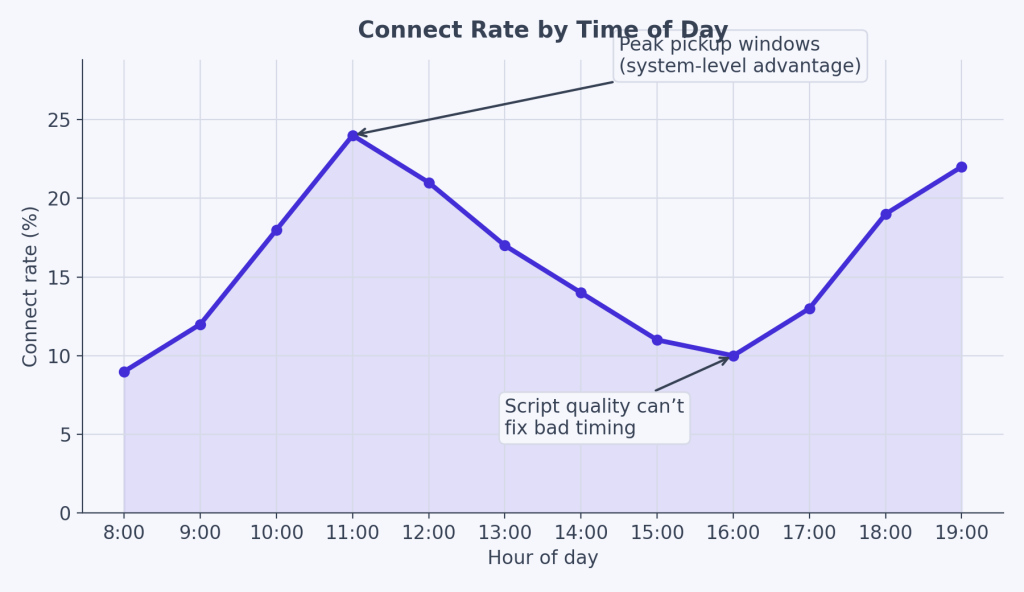
Connect rate is the percentage of dials that result in a human-being picking up the phone.
In traditional outbound sales, teams often accept mediocre connect rates as a fact of life. With AI voice agents, that assumption quickly kills your ROI.
What we see in practice is that connect rate is less about scripts and more about systems. Time-of-day routing, speed-to-dial, number reputation, voicemail detection accuracy, and retry logic all compound here.
A beautifully written script cannot rescue a system that calls at the wrong time of day, or dials the prospect too aggressively.
AI won’t forgive your infrastructure issues – it magnifies them instead.
Typically humans can compensate better, whereas AI will make the same mistake perfectly, over and over again, without intervention.
Key Lesson: when connect rate drops off, don’t touch the prompt first. Instead inspect latency in calls, retry spacing, and how quickly your agent abandons dead air.
When people think it’s the prompt that’s bad, it can often turn out to be delivery problems instead.
2. Qualification ratio: not all connects are equally valuable
A high connect rate can still hide a crappy outbound sales campaign.
Qualification ratio measures how many connected calls meet your defined qualification criteria.
From our experience, the best qualification ratios come from clear intent thresholds. The agent’s job is to detect interest, disinterest, or ambiguity quickly and then act decisively:
- escalate early when intent is real
- exit cleanly when prospect not interested
- execute accurate event logging
The exact definition varies by business, but the principle doesn’t:
Achieving outbound success with a voice agent is not simply about pumping a high volume of calls, it’s capturing intent at scale – this is the hidden value in using AI voice agents as an effective outbound sales channel.
3. Response speed is the most underrated outbound metric
Dialshark doesn’t sit waiting for someone to click a button. It behaves more like a predictive dialler, constantly deciding who to call, when to call, and what to do when someone picks up.
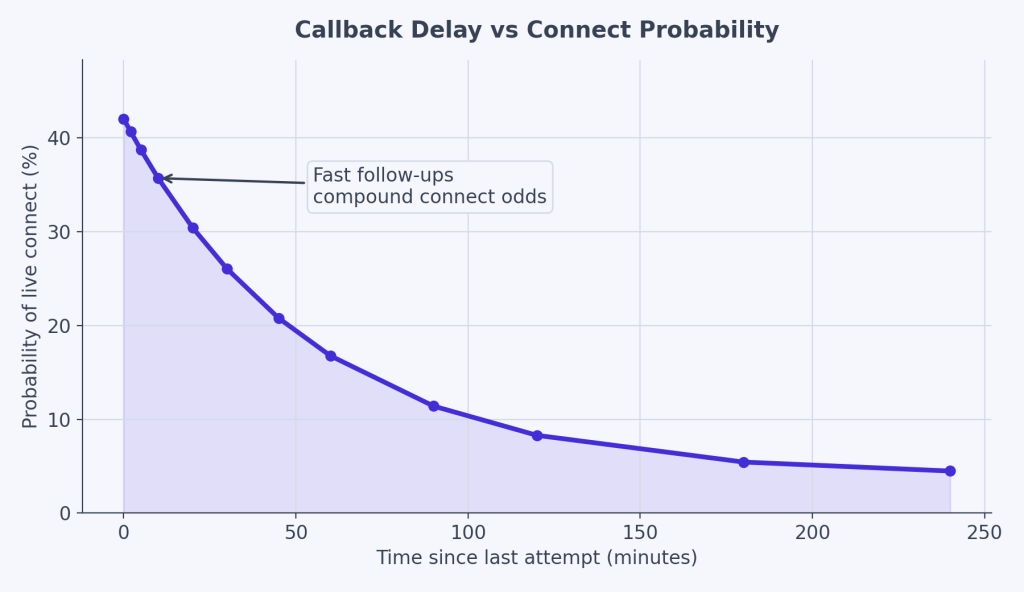
In AI outbound we consistently see that shorter gaps dramatically increase live contact probability, especially on second and third touches.
AI has a natural advantage here. No fatigue. No task switching. No “I’ll do it after lunch”. But the advantage only exists if your system is wired to exploit it. Poor orchestration can make AI slower than humans, even if it never sleeps.
At Dialshark we treat response speed obsessively. It’s important because every delayed callback, every stalled retry, every long pause between calls will eventually show up in what it costs you to acquire a new customer (CPA).
This is where the building our own relay layer, queue management, and failure handling quietly win or lose deals for you at scale.
Operational insight: speed compounds trust and delay reads as incompetence. Prospects are more forgiving of an AI voice when it feels responsive and timely.
4. CPA impact: The metric that gets the last word
Ultimately, outbound AI voice agents exist to improve unit economics. CPA, cost per acquisition or cost per qualified outcome, is where all the other metrics converge.
You can increase connect rate and qualification ratio, but if infrastructure costs are ballooning, you’ve built an impressive demo, not a business lever.
This is why we frame every deployment backwards from CPA:
- How many calls does it take to generate a qualified outcome?
- What’s the marginal cost per retry?
- Where does the system burn money silently?
AI makes these questions unavoidable, because it scales mistakes as efficiently as it scales wins.
The best outbound AI systems don’t chase maximum automation. They chase minimum waste. They end calls early, avoid dead numbers, and escalate to humans at the right moment.
Hard truth: if your AI voice agent doesn’t lower CPA within weeks, something fundamental is broken, regardless of how futuristic it sounds.
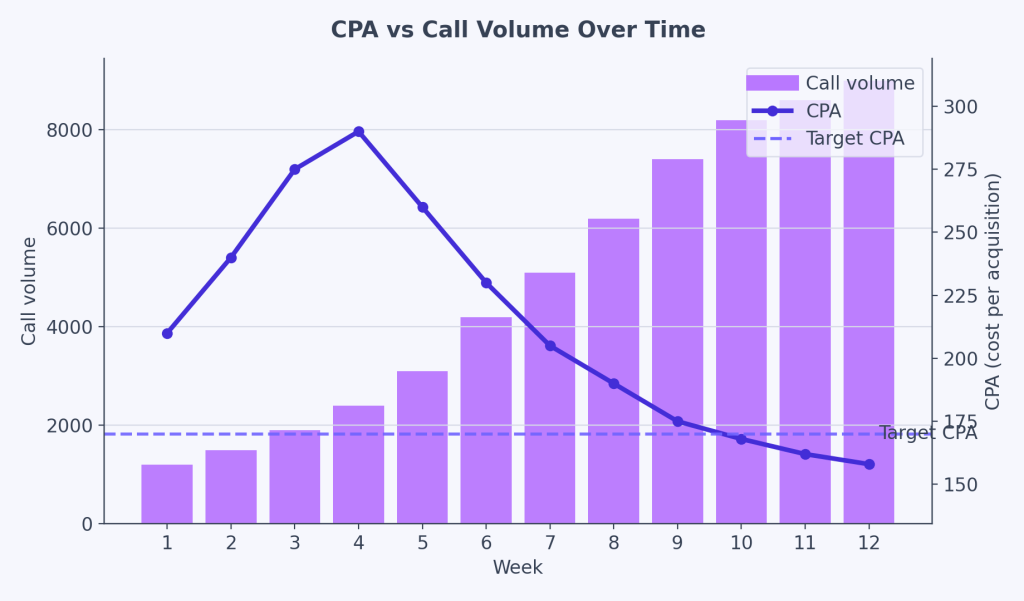
A simple framework we use at Dialshark
When evaluating or tuning an outbound AI voice agent, we run this checklist:
- Is connect rate improving week over week after adjusting delivery mechanics?
- Are qualified outcomes rising without longer calls or worse show-up rates?
- Are callbacks and retries happening faster than a human team could manage?
- Is CPA trending down once volume stabilises?
The biggest mistake teams make with AI voice agents is copying human KPIs without questioning them.
AI changes the shape of outbound. It exposes latency, waste, and bad assumptions faster than people ever could. That’s uncomfortable, but it’s also the opportunity. When you measure the right things, AI stops being a novelty and starts becoming infrastructure.
The teams that win aren’t the ones making the most calls. They’re the ones making the right calls, faster, cheaper, and with fewer surprises.
Are you ready to create a new outbound sales campaign with realtime AI voice agents?